Tina Schulz · 17 October 2026
Seasonal Winds and Their Overlooked Role in Reshaping Root Networks Across Remote Shoreline Thickets
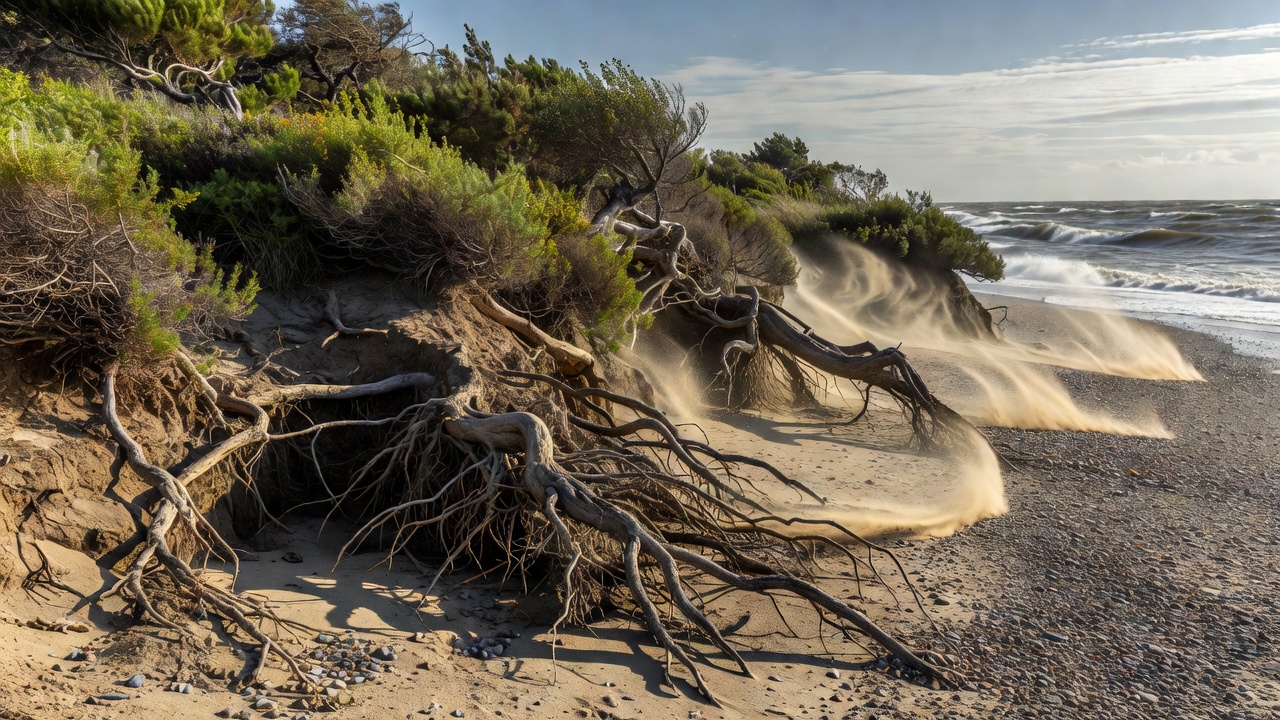
Seasonal winds interact with shoreline thickets in ways that extend well beyond surface vegetation, and researchers continue to document how these air movements drive structural changes in underground root networks. Data from coastal monitoring programs show that prevailing winds shift direction and intensity with each season, creating repeated mechanical stress on plants that grow in thin, sandy soils. Observers note that this stress prompts roots to reconfigure their growth patterns, seeking firmer anchorage while responding to altered soil moisture and nutrient distribution.
Remote shoreline thickets often consist of salt-tolerant shrubs and low trees whose root systems must contend with both wind force and periodic salt spray. Studies conducted along isolated stretches of coastline indicate that wind gusts during transitional seasons accelerate soil movement around root crowns, exposing some segments while burying others under shifting sediment. Those patterns become more pronounced in areas where thickets receive little human intervention and where natural wind corridors remain unobstructed.
Seasonal Wind Dynamics in Coastal Zones
Prevailing winds in many temperate and subtropical regions change their dominant direction between spring and autumn, and coastal stations record these shifts through anemometer arrays positioned near thicket margins. In October 2026, updated datasets from several long-term stations highlighted stronger than average cross-shore wind components that coincided with peak root elongation periods for several shrub species. These measurements reveal how wind speed and turbulence vary with distance from the waterline, creating micro-gradients that affect root development at different depths.
Trade winds and seasonal monsoonal flows dominate certain remote shorelines, while local katabatic drainage winds add complexity in mountainous coastal zones. Each regime delivers distinct loading patterns on stems and canopies, and the resulting torque transmits downward through the trunk into the root plate. Evidence gathered from root excavations shows that roots oriented perpendicular to prevailing wind directions thicken over successive seasons, while those aligned with wind flow remain comparatively slender.
Root Adaptation Processes Driven by Wind Stress
Mechanical loading from seasonal winds triggers thigmomorphogenetic responses in which plants modify cell wall composition and root architecture without any change in genetic makeup. Researchers have mapped these changes by comparing root biomass distribution in wind-exposed thickets against sheltered reference sites, finding consistent increases in lateral root density on the windward side. Soil particles displaced by gusts further influence root tip growth, directing new roots toward pockets of retained moisture beneath larger shrubs.
Wind also modulates evapotranspiration rates across the thicket canopy, which in turn alters the hydraulic gradient that roots must overcome to draw water from saline groundwater lenses. Data collected through sap-flow sensors indicate that plants in high-wind corridors adjust stomatal behavior and root hydraulic conductivity within days of sustained wind events. Over multiple seasons these adjustments accumulate into measurable shifts in root network topology.

Documented Patterns Across Geographic Regions
Surveys along the Pacific coast of North America and the southern coastline of Australia reveal parallel trends despite differences in plant species composition. In both regions, root networks in windward thickets develop more extensive horizontal spreads during the windier autumn months, while vertical taproots show slower growth until calmer periods return. A collaborative report released by the Australian Bureau of Meteorology in late 2025 linked multi-year wind records to corresponding changes in root biomass measured through ground-penetrating radar transects.
Similar observations appear in European dune systems where seasonal westerlies reshape thickets of sea buckthorn and willow. Canadian coastal research stations have reported comparable root reorientation in response to autumn gales that arrive after summer growth peaks. These geographically dispersed findings suggest that wind-driven root modification represents a widespread but under-monitored process in remote shoreline environments.
Interactions with Soil and Sediment Dynamics
Seasonal winds influence not only living roots but also the sediment matrix that supports them. Strong gusts during dry periods lift fine particles from exposed soil surfaces, gradually lowering the grade around root collars and forcing roots to extend deeper or laterally to maintain stability. Conversely, calmer wet seasons allow sediment deposition that can encase existing roots and stimulate new adventitious growth from buried stems.
Soil nutrient profiles shift as wind redistributes organic matter across the thicket floor, and roots respond by proliferating in zones of recent deposition. Measurements taken before and after major wind events demonstrate rapid colonization of these nutrient patches within weeks, illustrating how above-ground wind regimes translate into below-ground resource allocation strategies.
Conclusion
Seasonal winds therefore function as persistent sculptors of root architecture in remote shoreline thickets, operating through mechanical stress, sediment transport, and indirect effects on plant physiology. Continued monitoring programs, including those active in October 2026, provide the quantitative records needed to distinguish wind-driven changes from other coastal processes. As datasets accumulate across multiple continents, the extent of these overlooked interactions becomes increasingly clear to researchers focused on coastal ecosystem dynamics.